
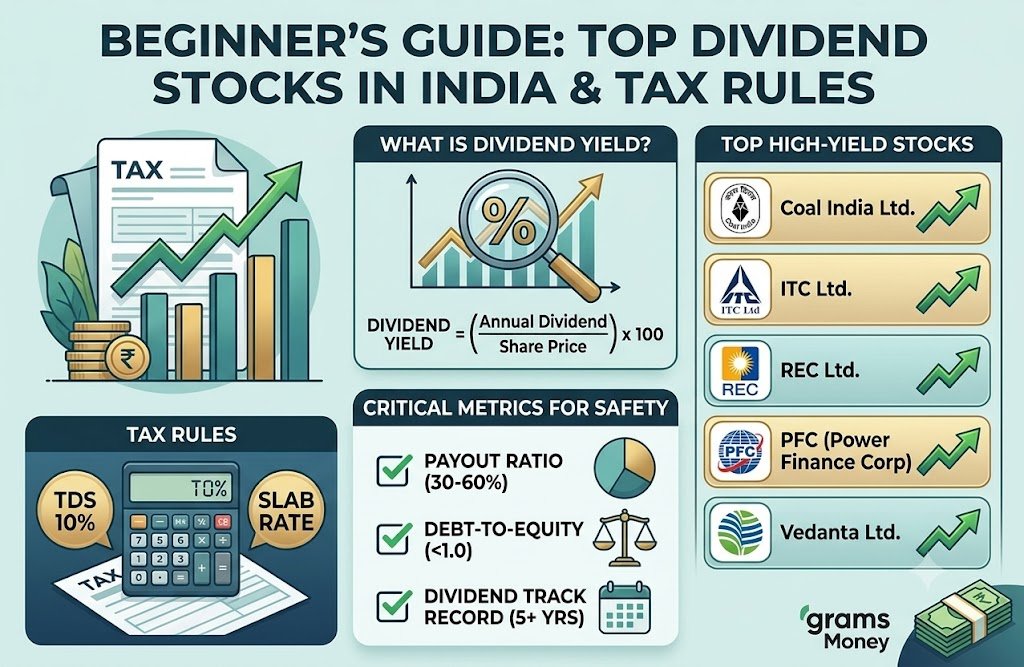
Top Dividend Yield Stocks in India: Stable Passive Income for Beginners
What Is Dividend Yield?
Dividend Yield (%) = (Annual Dividend per Share / Current Market Price) × 100
-
Example: A company trading at ₹500 that declares an annual dividend of ₹25 per share has a 5% dividend yield
(25 / 500 × 100).
Top High Dividend Yield Stocks in India
| Stock Name | Sector | Typical Dividend Yield Range | Key Strength |
| Coal India Ltd. | Energy / Mining | 7% – 9% | Monopoly status, near-zero net debt, high cash conversion |
| REC Ltd. | Financial Services (NBFC) | 6% – 8% | Critical infrastructure financing, consistent loan book expansion |
| Power Finance Corp (PFC) | Financial Services (NBFC) | 6% – 8% | Strategic power sector lending with government backing |
| Vedanta Ltd. | Metals & Mining | 8% – 12% | Diversified natural resources, aggressive payout track record |
| ITC Ltd. | FMCG / Diversified | 3% – 4.5% | Robust cash reserves, defensive business model, steady growth |
Critical Metrics Every Beginner Must Check
-
Dividend Payout Ratio: Look for companies paying between 30% and 60% of net profits as dividends. A payout ratio exceeding 100% means the company is paying out of debt or reserves, which is unsustainable.
-
Debt-to-Equity Ratio: Choose companies with a debt-to-equity ratio below 1.0 (excluding banking and NBFC firms) so debt servicing does not compromise future dividends.
-
Dividend Track Record: Prioritize businesses that have paid uninterrupted dividends for at least 5 to 10 consecutive years.
Tax Rules on Dividend Income in India
-
TDS Deduction: A 10% TDS is deducted at source if annual dividend payouts from a single domestic company exceed ₹5,000.
-
Slab Rate Taxation: Dividend earnings are added directly to your gross income under “Income from Other Sources” and taxed according to your applicable income tax slab rate.
How to Start
### Frequently Asked Questions (FAQs)
**What is a good dividend yield in the Indian stock market?**
A dividend yield between **4% and 7%** is generally considered attractive and sustainable in India. Anything consistently above 10% requires careful evaluation to ensure it is not a temporary value trap caused by a crashing share price.
**Are dividend earnings tax-free in India?**
No. Dividend income is added to your total income and taxed according to your individual income tax slab rates. If total dividends from a company exceed ₹5,000 in a financial year, a 10% TDS is deducted.
**Can beginners rely only on dividend stocks for long-term wealth?**
While dividend stocks provide regular income and stability during market downturns, relying solely on them can limit portfolio growth. A balanced approach combining high-yield dividend stocks with capital-growth businesses or index funds delivers optimal long-term compounding.
Always verify the record date and ex-dividend date before investing to ensure eligibility for upcoming dividend distributions. Setting up an automatic dividend reinvestment plan allows beginners to compound returns exponentially over long horizons.
[…] Top Dividend Yield Stocks in India […]